Beautifully Beyond
Botanical Skincare vs Chemical-Based Skincare: What Really Matters?
Botanical Skincare vs Chemical-Based Skincare: What Really Matters?
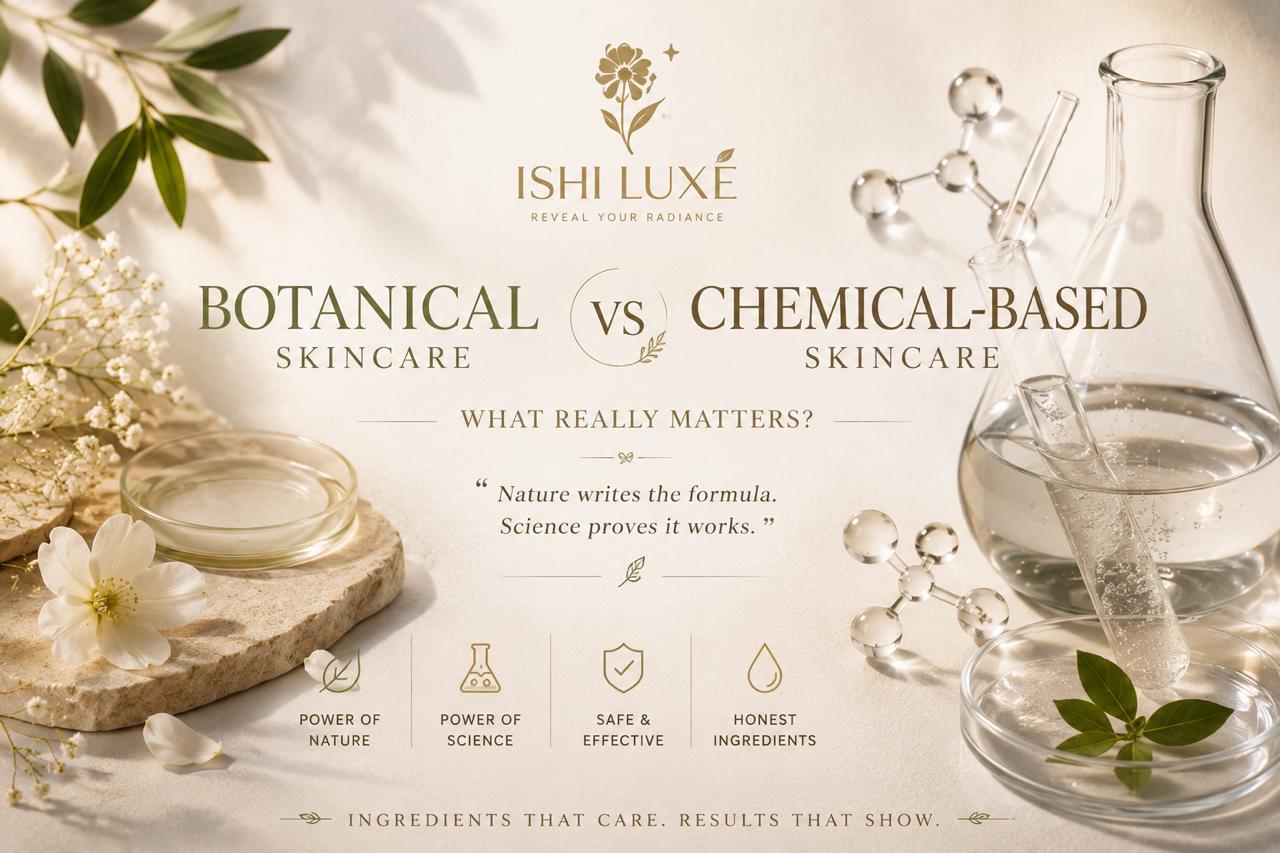
Botanical Skincare vs Chemical-Based Skincare: What Really Matters?
Somewhere between a Reel telling you to "go clean" and a dermatologist telling you retinol is non-negotiable, your skincare shelf became a battlefield. On one side: dewy jars of plant oils and flower extracts. On the other: lab-coded serums with names you can't pronounce. And you, standing in the middle, just wanting skin that behaves.
Here's the truth nobody puts on a bottle: the "botanical vs chemical" debate is a bit of a trick question. Every single ingredient on earth, like rose petal or retinoid, is technically a chemical. Water is a chemical. So the real question isn't natural or synthetic. It's what actually works, what's safe long-term, and what's honest about how it's made.
This isn't another "clean beauty is a scam" hot take, and it isn't a love letter to synthetic chemistry either. It's the version of this debate that actually holds up once you look past the packaging, the ingredient science, the myths marketing loves to repeat, and the one question that should decide every purchase you make from here on out.
Let's get into it.
"Nature writes the formula. Science proves it works." That's not a tagline, that's the only skincare philosophy that survives a chemistry exam.
What Is Botanical Skincare, Exactly?
Botanical skincare is any formulation built primarily on plant-derived ingredients like extracts, oils, butters, and actives sourced from roots, leaves, flowers, and seeds rather than lab-synthesized compounds.
Think:
? Turmeric (Curcumin) — anti-inflammatory, brightening
? Centella Asiatica (Cica) — wound-healing, barrier repair
? Bakuchiol — a plant-based retinol alternative
? Licorice root — soothes redness and evens tone
? Aloe vera & rosehip oil — hydration and regeneration
How It's Actually Made
Good botanical skincare isn't just "crushed flowers in a jar." It's extracted, stabilized, and tested with the same rigor as any lab-made active: cold-pressed, fermented, or bio-fermented to boost potency without stripping the plant's natural compounds. The best botanical brands don't romanticize nature; they engineer it responsibly.
What Is Chemical-Based Skincare, Really?
This is where most people get it wrong. "Chemical-based" skincare usually refers to lab-synthesized actives ingredients created (or isolated) in a controlled environment rather than harvested from a plant.
Common examples:
? Retinoids (Vitamin A derivatives)
? Hyaluronic Acid (usually bio-fermented, technically "synthetic" but not scary) ? Niacinamide (Vitamin B3, lab-produced for stability)
Here's the twist: some of skincare's most trusted, dermatologist-loved ingredients are synthetic because synthesis allows for precision, consistency, and purity that nature can't always guarantee from batch to batch.
Why "Synthetic" Isn't a Dirty Word
A lab-made molecule isn't automatically "fake" or "harsh." Synthesis simply means a compound is built to an exact, repeatable structure, no seasonal variation, no soil-quality lottery, no risk of contamination from a bad harvest. That's why niacinamide in your serum today performs identically to the one you bought six months ago. Nature is brilliant, but it isn't always consistent and consistency is what your skin barrier actually needs.
Botanical vs Chemical: Which Suits Your Skin Type? Neither camp wins across the board, it genuinely depends on what your skin is dealing with:
? Oily & Acne-Prone Skin — Often responds well to niacinamide (chemical) alongside neem or tea tree (botanical) for a balanced, non-clogging routine.
? Dry & Dehydrated Skin — Thrives on rosehip oil, shea butter, and squalane (botanical-leaning), paired with hyaluronic acid (bio-fermented "chemical") for deep hydration.
? Sensitive & Reactive Skin — Needs fewer actives overall, whether plant or lab-made, think centella asiatica and ceramides over heavily fragranced essential oil blends.
? Mature Skin — Benefits from bakuchiol or peptide-rich formulas, both proven to support collagen without the irritation risk of high-strength retinoids.
The lesson: match the ingredient to the concern, not to a philosophy.
The Real Battle: 5 Things That Actually Matter
Forget "natural vs chemical." Here's what should actually decide what you put on your face:
1. Efficacy — Does it visibly change your skin, or just smell nice?
2. Safety & Testing — Is it dermatologically tested, or just "inspired by nature"?
3. Skin Compatibility — Some botanicals (hello, essential oils) irritate sensitive skin more than "chemicals" do.
4. Stability — Plant actives can degrade fast without proper formulation; synthetics are often engineered to last.
5. Transparency — Can the brand tell you exactly what's in the bottle and why or are you buying a vibe?
Fun Fact
Poison ivy, arsenic, and snake venom are all 100% "natural." Meanwhile, Vitamin C in your serum is often lab-synthesized and it's one of the most researched, skin-loving ingredients that exists. Natural ? automatically safe. Synthetic ? automatically harsh.
Busting the Three Biggest Myths
Myth 1: "If it's natural, it's automatically gentle."
Reality: Essential oils like lemon, cinnamon, and even lavender are common causes of contact irritation and photosensitivity. Nature doesn't come with a built-in safety filter for formulation and dosage.
Myth 2: "If it's chemical, it's automatically harmful."
Reality: Ingredients like niacinamide, peptides, and hyaluronic acid are synthesized precisely because it makes them more stable, more bioavailable, and easier to standardize for safety. "Lab-made" often means "better quality-controlled," not "dangerous."
Myth 3: "More natural ingredients on the label = better formula."
Reality: A 20-ingredient "botanical blend" isn't automatically superior to a targeted 5-ingredient formula with clinically effective concentrations. What matters is whether each active is present at a dose that actually does something, not how long or leafy the ingredient list looks.
The skin doesn't care where an ingredient came from. It only responds to what the formula actually delivers.
So What Really Matters?
Not the plant-vs-lab label on the front of the bottle but what's behind it.
The smartest skincare today doesn't pick a side. It borrows the best of both worlds:
? Botanical wisdom for gentleness, heritage actives, and skin-loving compounds refined over centuries of use
? Scientific validation for stability, dosage accuracy, and dermatological safety
This is exactly why "botanical-science" skincare plant-first formulas that are lab-tested, not just lab-inspired, are quietly becoming the smarter choice for people who want results and peace of mind.
A Quick Litmus Test Before You Buy
Ask any product these three questions:
1. Is the active ingredient backed by research, not just folklore?
2. Has the formulation been dermatologically or clinically tested?
3. Is the brand transparent about sourcing, concentration, and process?
If a brand can say yes to all three botanical or not it's earned a spot on your Shelf
How to Actually Read a Skincare Label
Most of us skim ingredient lists like they're in another language because, honestly, they kind of are. Here's a quick decoder:
? INCI names sound scary but aren't — "Tocopherol" is just Vitamin E. "Aqua" is water. Latin-sounding ? synthetic or dangerous.
? Order matters — ingredients are listed by concentration, highest to lowest. If your "hero botanical" is item #14 out of 20, it's likely there for marketing, not efficacy.
? Percentages beat poetry — a label that states "2% Bakuchiol" tells you more than one that says "infused with nature's wisdom."
? Certifications are shortcuts, not guarantees — GMP, ISO, and dermatologically-tested stamps indicate process rigor, but they don't replace checking active concentrations yourself.
Once you can read past the marketing language, "botanical vs chemical" stops being a philosophical debate and becomes a simple checklist.
Don't Forget Sourcing & Sustainability
There's a quieter dimension to this debate that most "natural vs synthetic" articles skip entirely: where does the ingredient actually come from, and what did it cost the planet to get there?
? Over-harvested botanicals — Popularity has a downside. Ingredients like sandalwood and certain rare orchids have faced overharvesting as demand spiked, straining ecosystems that take years to recover.
? Responsibly synthesized alternatives — Lab-grown or biofermented versions of in-demand actives (like bio-identical squalane replacing shark-liver squalene) can actually reduce ecological strain compared to their "natural" counterparts.
? Traceable, ethical sourcing — Whether botanical or synthetic, ask if the brand can trace its supply chain; fair-trade sourcing, minimal-impact extraction, and cruelty-free testing matter more than the ingredient's origin story alone.
Sustainability, in other words, isn't a "team botanical" trophy. It's a separate axis entirely, and the smartest formulas take a hard look at both.
Where Ishi Luxe Fits In
At Ishi Luxe, we never bought into the "pick a side" debate. India's botanical heritage, Ayurvedic herbs, Himalayan flora, and temple-rooted rituals meet modern, dermatologically tested, clinically validated science in every formulation. Every Pavishe' and Sumishe' product is plant-first by philosophy and lab-tested by discipline, because we believe beauty shouldn't have to choose between heritage and evidence.
It's not about being all-natural for the sake of a label. It's about being honest, tested, and effective botanical roots, scientific proof.
FAQs: Botanical vs Chemical Skincare
Q1. Is botanical skincare better than chemical-based skincare?
Not universally. Botanical skincare tends to be gentler and rich in antioxidants, but "better" depends on formulation quality, testing, and how well it suits your specific skin concern, not just its ingredient origin.
Q2. Are all-natural products always safe for sensitive skin?
No. Many natural extracts (especially essential oils) can trigger irritation or photosensitivity. Sensitive skin often does better with well-tested, low-irritant formulas, natural or synthetic.
Q3. What does "plant-based, lab-tested" actually mean?
It means the formula is built around botanical actives, but every batch is validated through dermatological or clinical testing for safety, stability, and efficacy, not just marketed as natural.
Q4. Can botanical skincare deliver the same results as retinol or niacinamide?
Increasingly, yes. Ingredients like bakuchiol (a plant-based retinol alternative) and licorice root extract are showing comparable results in studies, when formulated correctly.
Q5. How do I know if a botanical skincare brand is genuinely science-backed?
Look for dermatological testing certifications, ingredient transparency, third-party lab validation (GMP/ISO/FDA where applicable), and clear communication of active concentrations, not just words like "pure" or "clean."
Q6. Is chemical-based skincare bad for the environment?
It depends on sourcing and manufacturing, not the synthetic-vs-natural label alone. Some synthetic actives are more sustainably produced (via biofermentation) than certain over-harvested "natural" ingredients.
Q7. Should I switch my entire routine to botanical skincare?
Not necessarily overnight. A smarter approach is auditing your current routine ingredient by ingredient, replacing products that lack testing or transparency, and prioritizing formulas, plant-based or synthetic, that are proven to suit your specific skin concerns.
Q8. Why do some botanical products cost more than chemical-based ones?
Quality botanical sourcing (organic farming, cold-pressing, biofermentation) is often more labor and resource-intensive than lab synthesis at scale, which is why premium botanical-science formulas tend to carry a higher price point reflecting sourcing integrity, not just branding.
The Bottom Line
Botanical vs chemical was never really the fight. The real question is: does your skincare respect your skin enough to be tested, transparent, and true to what it claims?
Choose formulas, not slogans. Choose proof, not just petals.
The next time you're standing in front of a skincare shelf, torn between a rose-gold botanical serum and a clinical-looking chemical peel, skip the either/or.
Ask instead: Is this ingredient right for my skin concern? Has it been tested? Is the brand honest about what's actually inside?
That's the only "side" worth picking.
Beautifully Beyond starts with what you choose to believe about your skin and what you choose to trust in it.